
0 参考
[vector-isa-support]([PATCH -next v20 00/26] riscv: Add vector ISA support - Andy Chiu (kernel.org))
[vector-1.0-spec](riscv/riscv-v-spec: Working draft of the proposed RISC-V V vector extension (github.com))
[vector-1.0解读](【个人笔记】RISC-V “V” Vector Extension Version 1.0 - 知乎 (zhihu.com))
1 背景
[PATCH -next v21 00/27] riscv: Add vector ISA support - Andy Chiu (kernel.org)在这个实现中,有一些假设:
- 我们假设系统中的所有harts都具有相同的ISA。
- 默认情况下,我们在内核和用户空间中禁用向量。只有在一个非法指令陷阱(第一次使用陷阱)中,实际开始执行向量后,才启用用户的向量。
- 我们检测 “riscv,isa” 来确定是否支持向量。
我们在结构体 thread_struct 中定义了一个新的结构体 __riscv_v_ext_state,用于保存/恢复与向量相关的寄存器。它用于内核空间和用户空间。
- 在内核空间中,
__riscv_v_ext_state中的 datap 指针将被分配用于保存向量寄存器。 - 在用户空间中:
- 在用户空间的信号处理器中,该结构体位于
__riscv_ctx_hdr之后,该结构体嵌入在fp保留区域中。这是为了避免ABI中断。并且datap指向__riscv_v_ext_state的末尾。 - 在ptrace中,数据将被放入ubuf中,我们使用
riscv_vr_get()/riscv_vr_set()从ubuf中获取或设置__riscv_v_ext_state数据结构,datap指针将被清零,向量寄存器将被复制到ubuf中__riscv_v_ext_state结构体后的地址。
- 在用户空间的信号处理器中,该结构体位于
重点关注以下几点:
- vector的Trap处理
- vector的上下文保存与恢复
2 解析
2.1 vector_trap
ISA
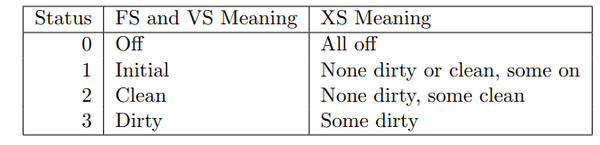
mstatus/sstatusA vector context status field,
VS, is added tomstatus[10:9]and shadowed insstatus[10:9]. It is defined analogously to the floating-point context status field,FS.Attempts to execute any vector instruction, or to access the vector CSRs, raise an illegal-instruction exception when
mstatus.VSis set to Off.When
mstatus.VSis set to Initial or Clean, executing any instruction that changes vector state, including the vector CSRs, will changemstatus.VSto Dirty. Implementations may also changemstatus.VSfrom Initial or Clean to Dirty at any time, even when there is no change in vector state.
vsstatusWhen the hypervisor extension is present, a vector context status field,
VS, is added tovsstatus[10:9]. It is defined analogously to the floating-point context status field,FS.When V=1, both
vsstatus.VSandmstatus.VSare in effect: attempts to execute any vector instruction, or to access the vector CSRs, raise an illegal-instruction exception when either field is set to Off.When V=1 and neither
vsstatus.VSnormstatus.VSis set to Off, executing any instruction that changes vector state, including the vector CSRs, will change bothmstatus.VSandvsstatus.VSto Dirty. Implementations may also changemstatus.VSorvsstatus.VSfrom Initial or Clean to Dirty at any time, even when there is no change in vector state.If
vsstatus.VSis Dirty,vsstatus.SDis 1; otherwise,vsstatus.SDis set in accordance with existing specifications.If
mstatus.VSis Dirty,mstatus.SDis 1; otherwise,mstatus.SDis set in accordance with existing specifications.For implementations with a writable
misa.Vfield, thevsstatus.VSfield may exist even ifmisa.Vis clear.
fpsimd_state
1 | union __riscv_fp_state { |
考虑到 vector_context 的大小可能变化且可能很大,它们被保存在动态分配的内存中,由__riscv_v_ext_state 中的datap指针指向。
trap_control/handle
流程如下:
系统启动,主/从核拉起时,设置fpsimd为OFF状态;
1
2
3
4
5
6
7
8
9
10
11
12
13
14
15
16SYM_CODE_START(_start_kernel)
/*
* Disable FPU & VECTOR to detect illegal usage of
* floating point or vector in kernel space
*/
li t0, SR_FS_VS
csrc CSR_STATUS, t0
.global secondary_start_sbi
secondary_start_sbi:
/*
* Disable FPU & VECTOR to detect illegal usage of
* floating point or vector in kernel space
*/
li t0, SR_FS_VS
csrc CSR_STATUS, t0进程在用户态首次执行fpsimd指令,陷入处理并返回:
向量单元默认情况下对所有用户进程都是禁用的。因此当进程首次使用向量时,它会因非法指令而陷入内核。只有在那之后,内核才会为该用户进程分配vector上下文,并开始管理该上下文。
1
2
3
4
5
6
7
8
9
10
11
12
13
14
15
16
17
18
19
20
21
22
23
24
25
26
27
28
29
30
31
32
33
34
35
36
37
38
39
40
41
42
43
44
45
46
47
48
49
50
51
52
53static int riscv_v_thread_zalloc(void)
{
void *datap;
datap = kzalloc(riscv_v_vsize, GFP_KERNEL);
if (!datap)
return -ENOMEM;
current->thread.vstate.datap = datap;
memset(¤t->thread.vstate, 0, offsetof(struct __riscv_v_ext_state,
datap));
return 0;
}
bool riscv_v_first_use_handler(struct pt_regs *regs)
{
u32 __user *epc = (u32 __user *)regs->epc;
u32 insn = (u32)regs->badaddr;
/* Do not handle if V is not supported, or disabled */
if (!(ELF_HWCAP & COMPAT_HWCAP_ISA_V))
return false;
/* If V has been enabled then it is not the first-use trap */
if (riscv_v_vstate_query(regs))
return false;
/* Get the instruction */
if (!insn) {
if (__get_user(insn, epc))
return false;
}
/* Filter out non-V instructions */
if (!insn_is_vector(insn))
return false;
/* Sanity check. datap should be null by the time of the first-use trap */
WARN_ON(current->thread.vstate.datap);
/*
* Now we sure that this is a V instruction. And it executes in the
* context where VS has been off. So, try to allocate the user's V
* context and resume execution.
*/
if (riscv_v_thread_zalloc()) {
force_sig(SIGBUS);
return true;
}
riscv_v_vstate_on(regs);
riscv_v_vstate_restore(current, regs);
return true;
}用户态首次vector_trap将分配实际内存,用于保存/恢复vector上下文,返回用户态之前将
sstatus.VS设置为Initial。之后用户态将正常使用vector。
2.2 vector_context_switch
相较于通用寄存器组,vector上下文更庞大。因此在大量使用vector的场景中,需要尽可能的避免vector上下文的保存/恢复,降低系统开销。在多核多进程系统中,内核需要跟踪比对 task - cpu 的 (绑定指向) 状态以确定某一次的vector上下文的保存/恢复上是否 “真的有必要”。先看一下目前内核在该问题的处理方式。
kernel: context_save/restore
1 | static inline void riscv_v_vstate_save(struct task_struct *task, |
vector-1.0-spec 中有一句注释:
Accurate setting of
mstatus.VSis an optimization. Software will typically use VS to reduce context-swap overhead.
内核中也确实这么做了,这是硬件的优化机制:
- vector上下文如果为DIRTY状态,保存的时候就必须去硬件上拉取最新的内容,否则就不需要做任何工作;
- vector上下文如果为OFF状态,恢复的时候就无需做任何工作,否则就必须恢复vector上下文状态;
内核最近提了一组PATCH,考虑了这样一种调度场景:
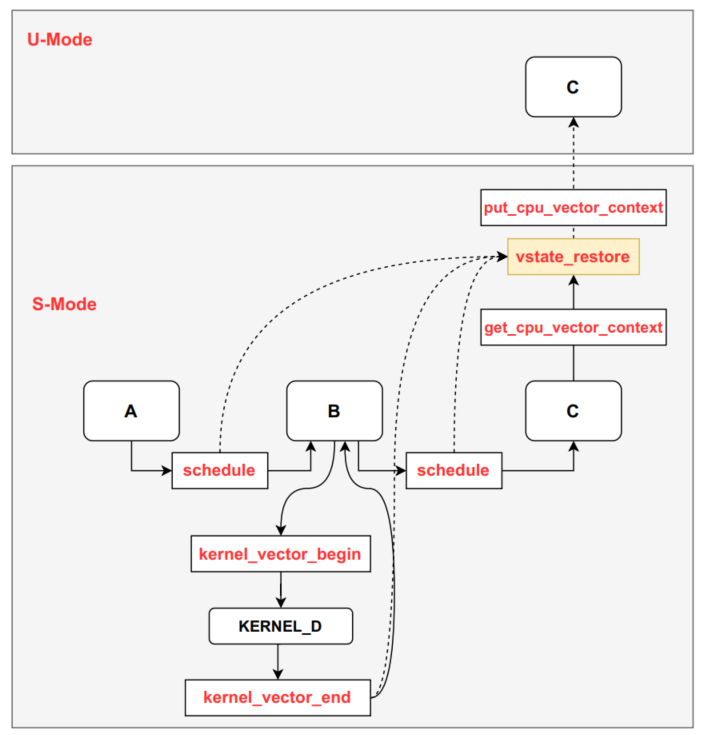
用户只有在内核真正返回到用户空间后才会使用其向量寄存器。因此,只要我们还在内核模式下运行,可以延迟恢复向量寄存器。内核需要添加一个线程标志以指示是否需要恢复向量,并在最后的特定于架构的退出用户模式的临界点处进行恢复。这样可以节省在内核模式下切换多个运行V操作的进程时的上下文恢复开销。
举个例子:如果内核执行
A->B->C的上下文切换,并最终返回到 C 的用户空间,那么就没有必要恢复 B 的vector寄存器。此外,这还可以防止我们在多次执行内核模式的向量操作时重复恢复vector上下文。这样做的代价是,在执行
vstate_{save,restore}期间我们必须禁用抢占并将向量标记为忙碌。因为如果在vstate_{save,restore}过程中发生导致陷阱的上下文切换,vector上下文将不会立即恢复。
1 | riscv_v_first_use_handler |
总体来说,将vector恢复工作推迟到返回用户态的节点,有两个优势:
- S-Mode下无论发生了多少次抢占,内核只关注返回用户态的那个task,中间的多个
task_vector_context没必要恢复; - S-Mode下也可能会使用vector,这种情况下会覆盖掉用户态的vector上下文,内核必须在使用vector前保存用户态vector上下文,在使用vector结束时恢复。但S-Mode有可能多次执行向量操作时,内核没必要重复恢复vector上下文,因此也是标记一个
REFER_RESTORE,一并推迟到返回用户态的节点;
kvm: context_save/restore
KVM: Add vector lazy save/restore support
1 | kvm_arch_vcpu_load |
存在的缺陷:
对于
kvm_arch_vcpu_load:kvm_riscv_vcpu_host_fp_save/kvm_riscv_vcpu_host_vector_save仅检查是否支持f扩展,就直接保存host状态 => 考虑guest对fp/vector的使用情况,应该延迟保存
kvm_riscv_vcpu_guest_fp_restore/kvm_riscv_vcpu_guest_vector_restore仅检查
vsstatus.FS != SR_FS_OFF和vsstatus.VS != SR_VS_OFF,说明guest已允许float/vector指令的执行,直接恢复guest状态- 如果条件判断为guest禁用了float/vector_trap,恢复其上下文完全没有问题;但考虑这样一种情况:host没使用过float/vector指令,当前pCPU的float/vector寄存器仅为guest所用,guest此时完全不需要执行本次恢复工作。
- 如果条件判断为guest启用了float/vector_trap,那么之前的host状态完全没必须要保存;
最后整理于 2025-11-11